
Fiscal Compliance
Desktop POS ensures fiscal compliance by routing every sale through a locally connected SDC, which signs each invoice with a cryptographic signature before it is issued. This page explains the SDC connection, the signing process, and the regulatory constraints built into the application.
The SDC Connection
Desktop POS connects to a local E-SDC at a configured host and port (default: localhost:8888). The connection status is shown in a status indicator on the main screen.
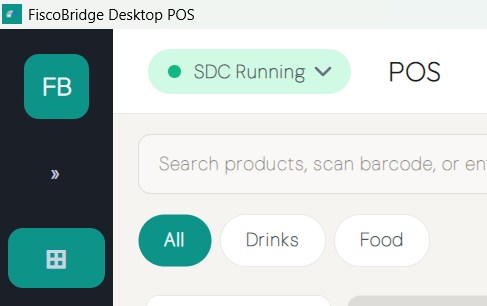
The status indicator reflects the following states:
State | Meaning |
|---|---|
Reachable | The SDC host responds at the configured address |
Card Present | A smart card is inserted in the SDC card reader |
PIN Verified | The smart card PIN has been successfully entered and verified |
Initialized | The SDC is fully initialized and ready to sign invoices |
Audit Required | The SDC requires an audit action before normal operation can resume |
Certificate Expiry | The smart card certificate is approaching or has passed its expiry date |
For full technical details — serial number, software version, and last invoice number — tap the status indicator to open the SDC details panel.
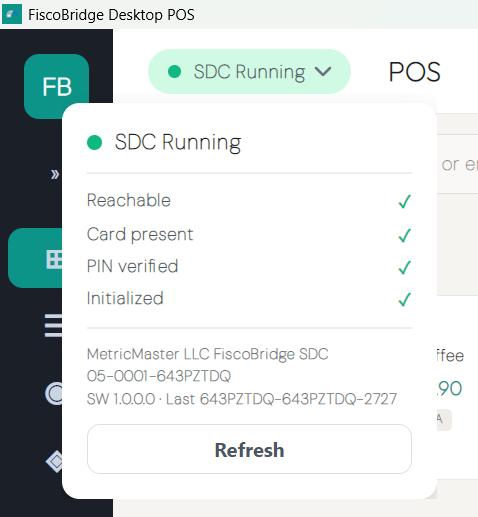
Note: If the SDC is offline, the card is absent, or the PIN is not verified, sales cannot be fiscalized.
SDC Authentication
When Desktop POS starts an operation, the POS and the E-SDC are mutually authenticated before any invoice can be issued:
The POS opens a session with the SDC at the configured host and port
The smart card must be present in the SDC and its PIN verified — this proves the SDC holds a valid, authority-issued certificate
The SDC returns its configuration (tax labels and environment parameters); only after successful mutual authentication does the status reach Initialized and the Fiscalize action become available
This ensures that only an authorized POS paired with a valid, initialized SDC can issue fiscal invoices.
SDC Communication Protocol
Desktop POS communicates exclusively with a local E-SDC, using the HTTP protocol as documented in the Technical Instructions for EFD Suppliers. Desktop POS never connects to a V-SDC and never uses HTTPS for SDC communication.
Signing a Sale
Every invoice issued by Desktop POS is signed by the SDC before it is presented to the customer. The signing process:
Desktop POS sends the invoice request (items, quantities, tax labels, payment method, cashier, and buyer TIN where applicable) to the SDC
The SDC validates, signs, and returns the fiscal result — invoice number, SDC timestamp, invoice counter, tax breakdown, verification URL, QR code, and digital signature
Desktop POS displays and prints the result exactly as received, without modification
The POS cannot issue an invoice without a connected, initialized SDC. The fiscalize action is only available when the status indicator shows Initialized.
Training Mode
Desktop POS includes a training mode for staff onboarding and system testing. When training mode is active, a TRAINING MODE banner is shown across the sales screen. Invoices issued in training mode are clearly marked TRAINING, are not valid fiscal invoices, and are not reported to the tax authority. Use training mode to practice or train staff without affecting your fiscal records.
Training mode is enabled and disabled from Settings → System & Training.
Electronic Journal
An electronic journal is retained for every issued invoice. From Invoice History, you can:
View every invoice with filtering by date, type, status, and cashier
Open the full details of any invoice, including its verification URL and QR code
Retrieve the SDC-issued journal text for any transaction
This provides a complete, searchable record of every fiscal transaction processed on the device.
Prohibited Functions
Desktop POS enforces the following restrictions as required by fiscal regulation:
Fiscal Records Are Never Edited or Deleted
Issued fiscal invoices cannot be modified or removed from the system. When a transaction must be reversed or corrected:
Refunds create a new linked refund invoice referencing the original
Cancellations create a new linked cancellation document referencing the original
Both the original and the linked document are reported and visible in Invoice History. Nothing is erased.
No Sales Without the SDC
It is not possible to register a sales amount without issuing a fiscal invoice. There is no offline or unrecorded sales mode for fiscal invoices.
No Modification of SDC Responses
Desktop POS does not omit, edit, or recalculate any data returned by the SDC. Tax breakdowns, invoice numbers, timestamps, and QR codes are displayed and printed exactly as received.
Invoice Header Must Include All Issuer Data
Header of fiscal invoice (identification of issuer) must not omit any data returned by SDC.
Audit Log
All administrative and POS actions — including shift opens and closes, cash movements, refunds, cancellations, settings changes, and PIN entries — are written to an audit log. The audit log can be reviewed from Settings and is also pushed to the Backoffice if the device is connected. See Settings for details.
Setting Up the SDC
The SDC must be installed, initialized, and have a smart card inserted before Desktop POS can issue fiscal invoices. For SDC installation, smart card registration, and PIN initialization, see the SDC documentation. For a step-by-step guide to pointing Desktop POS at the SDC and reading the connection status, see Connecting to the SDC.
Next Steps
Tax rates — How tax labels are sourced from the SDC and applied to sales
Daily report — Shift workflow and Z-report generation
SDC documentation — Installing and initializing the SDC